
Montessori floor beds are low-profile beds designed to give children greater independence and freedom around sleep. Unlike traditional beds, their low height allows children to safely get in and out on their own. Some families place the mattress directly on the floor, while others choose a low frame that provides space underneath for ventilation. Floor beds can be designed for infants, toddlers, or even shared use, depending on the size and configuration. With a simple, child-friendly design, Montessori floor beds create a comfortable sleep environment while supporting children’s natural development and growing autonomy.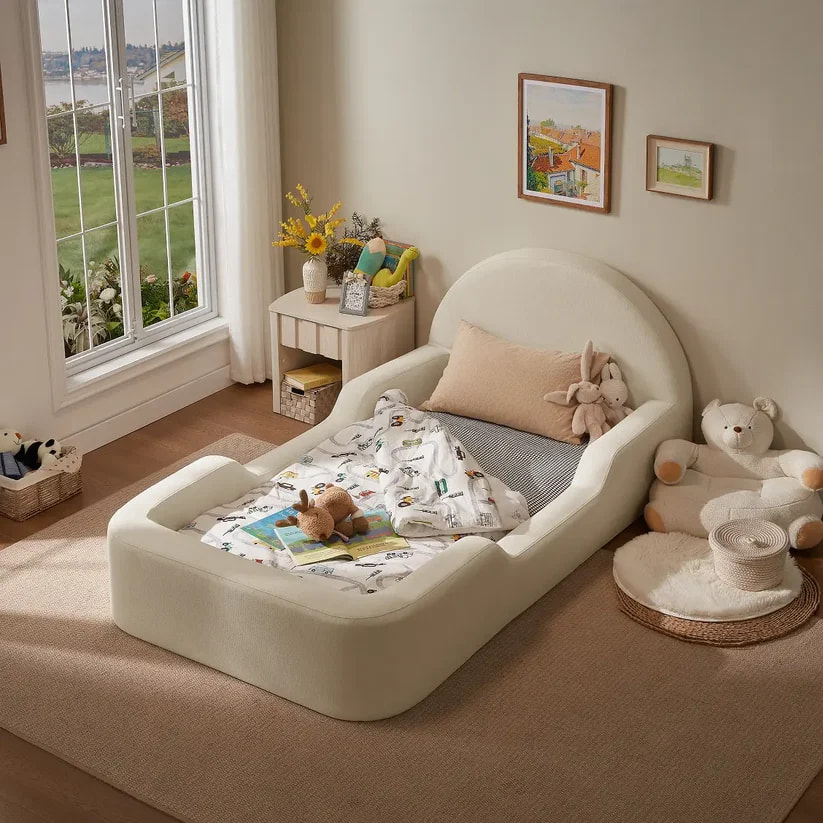
Dr. Maria Montessori’s approach to the bedroom was simple: the environment should be designed around the child’s needs, not just the parent’s convenience. A traditional crib limits a child’s movement. When they wake up, they cannot get out on their own—they cry and wait for a parent to come.
KINGSEN's Montessori floor bed creates a very different experience. Because the mattress is low to the ground, the child can get in and out independently. When they wake up, they have choices: they can get up, look at books, play with toys on a nearby low shelf, or simply relax in bed. Waking up no longer has to mean immediately calling for a parent.
For parents, a floor bed can also make nighttime wake-ups easier. When a toddler needs comfort at 2 a.m., it’s much easier to sit or lie beside them on a floor bed than to lean awkwardly over a crib rail. Once your child settles back to sleep, you can quietly slip away without disturbing them.
Regardless of when you transition your child to a floor bed, the sleep setup should meet essential safety requirements. Keep the following in mind:
A floor bed can be used from birth when it is set up safely, but there is no single “right” age to start. The best time depends on your child and what works for your family. In Montessori environments, some families introduce a floor bed after a baby outgrows a newborn bassinet, while others wait until their child is older.
Many health professionals recommend room-sharing with an infant for at least the first six months. A floor bed can still be used in the parents’ bedroom during this time, provided the sleep environment is set up safely and follows appropriate infant sleep guidelines.
Some common reasons families choose to transition to a floor bed include:
Moving away from bed-sharing or co-sleeping. A floor bed can be a helpful transition when parents want to move their baby out of their own bed but do not want to introduce a crib. This can be especially useful for babies around 9–12 months old who have never slept in a crib. Because a floor bed more closely resembles a regular bed, some families find the transition smoother.
The crib is no longer working. Babies and toddlers may struggle with crib transfers, become frustrated by restricted movement, or eventually start trying to climb out. A floor bed can provide an alternative sleep setup that gives the child more freedom while making bedtime and nighttime comforting easier for parents.
Safe floor-bed use requires attention to both the bed itself and the entire room, since a child can move freely around the space.
A floor bed is a low-profile bed or mattress placed close to the floor. Often called a Montessori bed, it allows children to get in and out independently while giving parents more flexibility than a traditional crib.
Families may choose a floor bed to make the transition from bed-sharing easier, reduce difficult crib transfers, and make nighttime comforting more convenient.
There is no single “right” age. Some families start after the newborn bassinet stage, while others transition between 6 and 12 months or when the crib is no longer working well.
Childproof the entire room by securing furniture, covering outlets, removing cords and choking hazards, and blocking access to unsafe areas. Use a firm mattress with a tight-fitting sheet, avoid dangerous gaps, and follow age-appropriate safe sleep guidance.
Introduce the new bed during the day through play, reading, or quiet time. Use familiar bedtime routines and give your child time to adjust to the new sleep space.
This is common at first. Keep the room fully childproofed, use consistent bedtime boundaries, and allow time for your child to learn the new routine. Gates or door alarms can help prevent access to unsafe areas.
A floor bed can be part of a safe sleep setup when the mattress and surrounding environment are age-appropriate and properly prepared. Always follow current safe sleep recommendations for your child’s age and development.


